

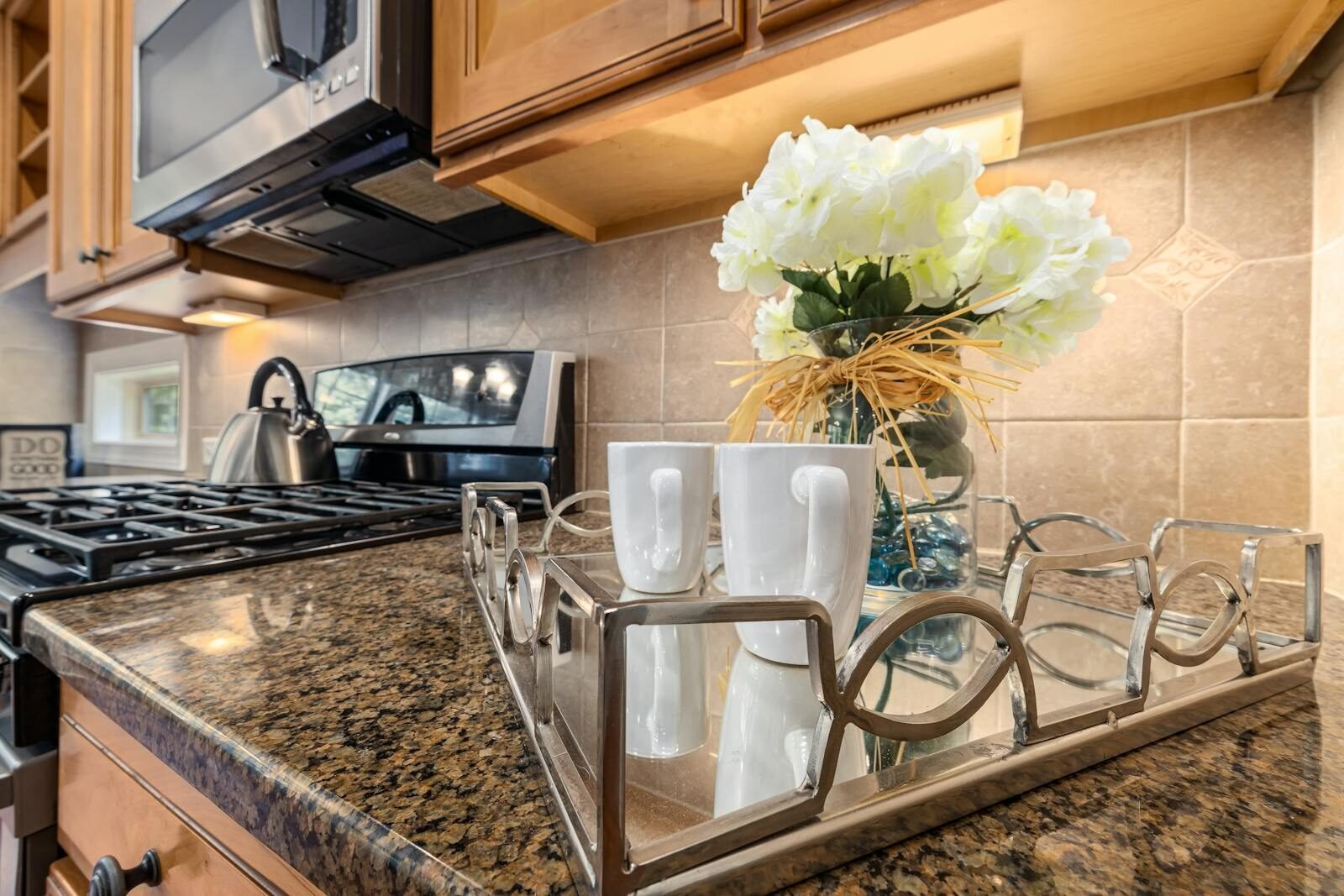
If you’ve recently installed granite countertops — or you’re finally about to — you already know that feeling of standing in your kitchen and thinking, now what goes behind it? The backsplash can make or break the whole look. Pick the wrong one, and your beautiful granite slab ends up fighting for attention. Pick the right one, and the two work together like they were always meant to be there.
I’ve spent years working with homeowners across the US, from open-concept kitchens in the Pacific Northwest to galley-style setups in Brooklyn brownstones, and the question I get most often is exactly this: What backsplash works best with granite countertops?
The answer depends on your granite’s color, pattern, and finish — but there are reliable principles that hold up every time. This guide walks you through the best granite countertop backsplash ideas for 2026, including trending styles, material options, and practical tips to help you make a confident decision.
Why the Backsplash-Countertop Pairing Matters More Than You Think
Granite is a natural stone. No two slabs are identical. That means your backsplash isn’t just a functional surface to protect your walls from splashes — it’s a design element that either amplifies what’s already in the stone or creates unnecessary visual noise.
The biggest mistake homeowners make is treating the backsplash as an afterthought. They choose their cabinets, countertops, and flooring — and then scramble to find something that “goes with everything.” That rarely ends well.
A well-chosen backsplash does three things:
- It pulls out one or two secondary tones already present in the granite
- It bridges the visual gap between the countertop and upper cabinets
- It defines whether your kitchen reads as warm, cool, modern, or transitional
Get this right, and your kitchen feels intentional. Get it wrong, and it looks like a beautiful countertop surrounded by indecision.
Understanding Your Granite Before You Shop
Before diving into specific backsplash ideas, take a close look at your granite slab — or bring a sample to the tile store. Here’s what to pay attention to:
Dominant Color: What’s the main background color? Black? Cream? Gray? Beige?
Secondary Colors and Veining: Granite often has flecks or veins of gold, burgundy, white, silver, or even blue. These are your design cues.
Pattern Density: Is the pattern busy with lots of movement, or relatively calm and uniform?
Finish: Polished granite is reflective and formal. Leathered or honed granite is matte and more casual.
Once you understand these four factors, the right backsplash options narrow down quickly.
1. Subway Tile: The Classic That Never Overstays Its Welcome
If your granite has a lot going on — heavy movement, multiple colors, dramatic veining — a simple subway tile backsplash is often the smartest choice. It recedes visually and lets the countertop be the star.
Best with: Busy granite patterns like Santa Cecilia, Giallo Ornamental, or Venetian Gold.
Color to choose: Match one of the lighter tones in the granite. If your granite has warm cream tones, choose an off-white or warm white subway tile. If it has cool gray undertones, go with a true white or light gray.
Trending in 2026: Handmade-style subway tiles with slightly uneven surfaces are everywhere right now. They add texture without competing with the stone. The “zellige-style” subway tile — Moroccan-inspired with an irregular glaze — has become especially popular in kitchens throughout California, Texas, and the Northeast.
Grout tip: Use unsanded grout in a tone that matches the tile (not the countertop). Contrasting dark grout on white subway tile was trendy a few years ago but now reads as dated in most modern kitchens.
2. Large-Format Porcelain Slabs: The Modern Statement
One of the biggest trends in US kitchen design right now is extending the countertop aesthetic up the wall with a large-format porcelain slab backsplash. When done well, it makes the kitchen feel larger, cleaner, and more luxurious.
Best with: Solid-colored or low-movement granite like Black Galaxy, Absolute Black, or Colonial White.
Why it works: With quieter granite, the large slab backsplash adds visual impact without overwhelming the space. It creates a seamless, high-end look that photographs beautifully — important if you’re planning to sell your home.
Popular options in 2026:
- Porcelain slabs in marble look: The Calacatta and Statuario-inspired porcelain slabs from brands like Dekton and Neolith have been gaining traction in high-end remodels.
- Fluted or ribbed porcelain panels: Textured surfaces add depth and a tactile quality that flat slabs lack.
- Thin stone veneer panels: Ultra-thin natural stone sheets (quartzite or marble veneer) used as a full backsplash wall — increasingly seen in luxury kitchen remodels in cities like Chicago, Miami, and Seattle.
Installation note: Large slab backsplashes require a skilled installer. Budget for it. Poor installation shows immediately.
3. Glass Tile: Light, Reflectivity, and a Bit of Drama
Glass tile has been a kitchen staple for over two decades, but the way designers are using it has evolved significantly. The opaque, single-color glass tiles from the early 2000s have been replaced by richer, more complex options.
Best with: Dark granite countertops like Black Pearl, Ubatuba, or Tan Brown.
Why it works: Against a dark granite, glass tile adds lightness and sparkle. The reflectivity of glass helps bounce light around the kitchen — practical in spaces that don’t get a lot of natural light.
What’s trending now:
- Iridescent or pearlescent glass tiles that shift color depending on the light angle
- Recycled glass tiles in sea-glass tones (sage, aqua, soft teal) — popular in coastal-style kitchens in Florida, the Carolinas, and along the Pacific Coast
- Mixed glass and natural stone mosaic sheets that bring together texture and light in one tile
Practical consideration: Glass tile shows water spots and fingerprints more readily than other materials. If your kitchen sees heavy daily use, factor in the maintenance commitment.
4. Natural Stone Backsplash: Cohesion Through Material Family
Using natural stone as a backsplash alongside granite countertops is a design move that feels inherently sophisticated. The key is not to use the exact same granite — that reads as monotonous — but to choose a complementary stone that belongs to the same visual family.
Best pairings:
- Travertine tile with warm-toned granites like Giallo Ornamental or New Venetian Gold
- Slate mosaic with dark granites like Black Galaxy or Blue Pearl
- Marble tile (Carrara or Thassos) with cool gray or white granites like Arctic White or Bianco Antico
Why it works: Natural stones share a sense of authenticity and organic variation. Two different natural stones in the same kitchen feel curated, not contrived — as long as the tones are harmonious.
Regional note: In the American Southwest — Arizona, New Mexico, Nevada — warm-toned travertine backsplashes alongside Santa Cecilia or Venetian Gold granite are particularly popular, tying into the Spanish Colonial and Pueblo Revival architectural traditions common in those areas.
5. Painted Brick or Exposed Brick: Industrial Warmth
If your kitchen has exposed brick walls or you’re working with a loft-style or industrial aesthetic, a brick backsplash behind granite countertops can look genuinely striking — provided the colors work together.
Best with: Warm-toned granites with gold, amber, or rust flecks. Think Santa Cecilia, Typhoon Bordeaux, or Giallo Napoleon.
Color approach: White-painted brick gives you the texture of brick without the visual competition of its natural red-orange tone. Natural brick works if your granite has warm undertones that echo the brick’s color family.
Where this works best: Older homes being renovated in cities like Boston, Philadelphia, Pittsburgh, and Chicago, where exposed brick is a structural feature rather than a design addition.
6. Mosaic Tile: Artistic Expression in Small Format
Mosaic tile — small tiles arranged in patterns or abstract designs — allows for a level of artistic expression that no other backsplash material offers. Done right, it transforms a kitchen wall into a focal point.
Best with: Calm, neutral granites that won’t compete. Think Colonial Cream, Kashmir White, or Silver Pearl.
Design approaches that work in 2026:
- Geometric mosaics in monochromatic tones — hexagons or diamonds in shades of white, cream, and light gray create visual interest without clashing with the stone
- Penny round tiles in metallic or natural stone finishes — a timeless choice that photographs well and adds texture
- Custom mural-style mosaics as a focal point behind the range — seen increasingly in high-end custom kitchen builds across the US
Budget note: Mosaic tile installation is labor-intensive. The tile itself may be reasonably priced, but skilled labor adds significantly to the total cost. In most US markets, expect to pay $15–$30 per square foot for installation alone.
7. Metal and Mixed-Material Backsplashes
Stainless steel, copper, and brass backsplash tiles have a long history in commercial kitchens and have been making a steady move into residential design.
Best with: Dark, dramatic granites — Black Absolute, Blue Bahia, or Emerald Pearl.
Why metal works here: The cool sheen of stainless steel or the warm glow of brushed brass creates a deliberate contrast with the organic texture of dark granite. It signals that the kitchen is both functional and designed.
2026 trends in metal backsplashes:
- Unlacquered brass is still going strong — its patina develops naturally over time, which homeowners are increasingly embracing rather than fighting
- Blackened steel panels for a moody, industrial look
- Copper tile mosaics in kitchens leaning into a warm, European farmhouse aesthetic
Maintenance reminder: Unlacquered metals patina and fingerprint more than sealed or lacquered versions. Some homeowners love this; others find it frustrating. Know which camp you’re in before committing.
8. The “No Backsplash” Look: Slabs to the Ceiling
Increasingly, high-end kitchen designers are eliminating the traditional backsplash altogether and running the countertop material — or a complementary slab — from the countertop surface straight up to the underside of the upper cabinets or all the way to the ceiling.
Best with: Premium granite slabs where the stone itself has enough visual weight and beauty to hold the wall — think Blue Bahia, Calacatta-style whites, or dramatic quartzite.
Why it’s gaining popularity: The look is extraordinarily clean and expensive-feeling. It removes grout lines, simplifies cleaning, and gives the kitchen an almost architectural quality.
Practical consideration: This approach requires careful slab matching if you’re using natural stone — you want the slabs to visually flow from horizontal to vertical. A skilled fabricator and installer are non-negotiable here.
What Design Professionals Say About Getting This Right
One principle that experienced kitchen designers consistently emphasize: always bring your granite sample to the tile store. Never shop for backsplash tile from memory or a photo on your phone. Colors shift dramatically under different lighting conditions and against different materials.
Also, order samples before committing. Most tile suppliers in the US offer sample tiles for a small fee. Live with them in your kitchen for a few days — look at them in morning light, afternoon light, and evening light with the overhead fixtures on. What looks perfect in the showroom can read completely differently in your actual space.
For more detailed guidance on planning your kitchen renovation budget and timeline, check out our complete kitchen remodeling guide — it covers everything from cabinetry to flooring to countertop selection in one place.
Staying Up to Date With Kitchen Design Trends
If you want to keep a pulse on what’s happening in residential kitchen design nationally, the National Kitchen & Bath Association (NKBA) publishes annual design trend reports that are genuinely useful — not just for industry professionals but for homeowners planning renovations. Their 2026 design trends report points to a continued move toward warm neutrals, natural textures, and personalized, less “showroom-perfect” kitchens that feel lived-in and authentic.
That tracks exactly with what I’ve been seeing on the ground. The kitchens that feel most satisfying to be in aren’t the ones that look like they came straight from a catalog — they’re the ones where every decision was made thoughtfully, with the specific stone, the specific light, and the specific life being lived in that kitchen in mind.
Final Thoughts
Granite countertops are a long-term investment. Most homeowners keep them for 15 to 20 years or longer. The backsplash you pair with them will be one of the most visible design decisions in your home — seen every morning over coffee, every evening while cooking.
Take the time to get it right. Bring samples together. Look at them in your actual space. Trust your instincts when something feels wrong, even if you can’t immediately articulate why.
The best backsplash for your granite countertop isn’t necessarily the most expensive one, the most popular one, or the one your neighbor chose. It’s the one that makes your kitchen feel complete — like it was always supposed to look exactly this way.