

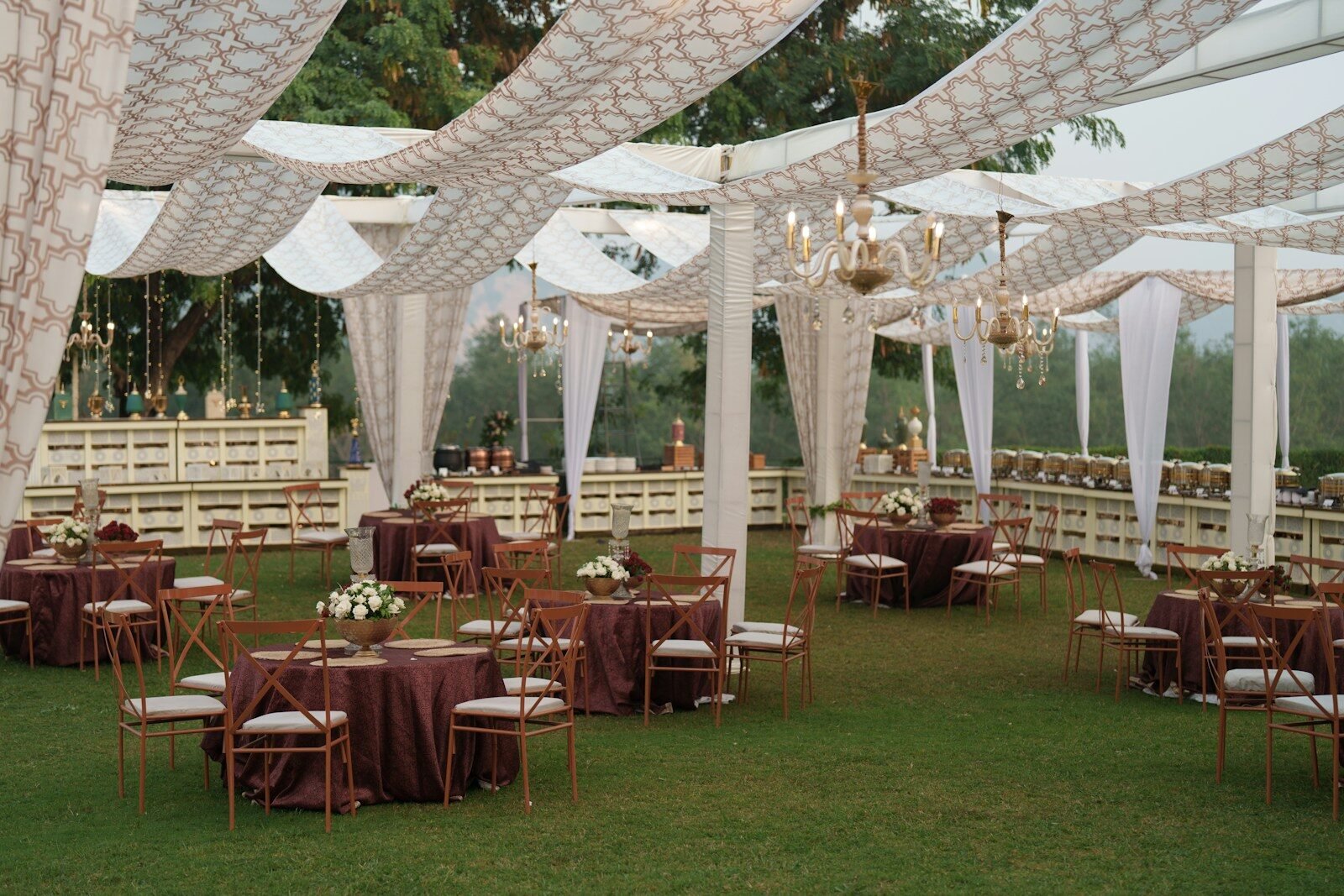
This was written by a certified wedding planner who has been in the business for more than 11 years and has planned more than 300 weddings Venue like ballrooms, barns, vineyards, and rooftops.
You already know what the problem is if you’ve started looking at venues. All of the venue websites say the same thing: “elegant,” “breathtaking,” and “unforgettable.” But none of that tells you if the parking lot will flood in October, if the kitchen can really handle 180 guests, or if the venue coordinator who sold you the dream will even be there on your wedding day.
This guide is not like the others. I’m going to show you how to choose a wedding venue like a pro. I’ll tell you the questions you should ask, the red flags that most couples miss, and the insider information that will make or break your wedding day.
Why Your Venue Is the Most Important Choice You’ll Make for Your Wedding
Let’s talk about the “why” before we get into the “how.”
Your venue is more than just a backdrop. It sets your guest list, budget, vendor list, timeline, and style all at once. It affects every other choice you make. The venue is the most important thing that affects everything else, like the florist you hire, the caterer you choose, and the music you can play.
I’ve seen couples spend 80% of their planning time on flowers and only two hours picking a place to hold the wedding. After that, they wonder why the day was so busy. If you make this choice correctly, almost everything else will fall into place.
Step 1: Before you look at anything, make sure you know what three things you can’t live without.
Most couples start looking at venues with a general idea of what they want, like “rustic,” “modern,” or “garden.” That’s not enough. Set your three non-negotiables before you go to any showrooms or click “Request a Quote.”
These are usually a mix of:
- Guest count—How many people are you really inviting? Not the “maybe” list. The real list.
- Flexibility with dates — Is your date set in stone, or can you move around during the season?
- Budget ceiling—This is the most you can spend on the venue, including all fees.
This is important because venues often hide the real cost by how they price and market themselves. A venue that costs $4,500 to rent may also require at least $18,000 in catering, $12 per car for valet parking, and a fee for cutting the cake. Before you even ordered a flower, your “affordable” venue cost $30,000.
Insider Tip: Always ask for the all-in minimum spend and not just the cost of renting the space. Ask, “What is the least amount a couple usually spends with you, including all service fees and vendor fees?” The answer will give you more information than any brochure.
Step 2: Learn about the four main types of venues and what they really mean for your day.
- Full-service venues, like hotels, banquet halls, and country clubs
These places take care of catering, tables, chairs, linens, and sometimes even decorations themselves. They’re ready to go. You’re not working with five different vendors; you’re working with one team.
Best for: Couples who want to plan their wedding without having to worry about the details.
The catch is that you have less control over your creativity. The linens are standard, the food is what it is, and customization costs extra. You are also often stuck with their list of preferred vendors.
- Raw or Blank-Canvas Venues (Lofts, Fields, and Industrial Spaces)
These places let you be as creative as you want. You bring everything, like tables, chairs, food, lights, and sometimes even bathrooms. The potential for beauty is amazing.
Best for: Couples who have a clear idea of what they want and either a planner or a very organized support team.
The problem is: The logistics are really hard. You have to rent, deliver, set up, and take down each item. Raw venues almost always cost more than they look like they do.
Tip from an insider:
If you’re looking at a raw space, ask the manager, “Who was the last planner to work here, and can I get in touch with them?” A planner who has worked in the space knows all the logistical problems, like where trucks can park, how long it really takes to set up, and which lighting rigs work.
- Outdoor and estate venues, like farms, vineyards, and private estates
Some of the most beautiful places to hold events are also some of the most dangerous. When you’re inside, you don’t have to worry about weather, noise laws, parking, or generator power.
Best for: Couples who like natural light, being outside, and a calm atmosphere.
The catch: Always have a plan for bad weather that is written down in a contract. Not “we’ll work something out.” Ask, “What is the exact rain plan, where will guests be moved, and how much will it cost?”
- Unique places to visit, like rooftops, museums, and historic buildings
These places have a wow factor that no other place can match. They also have layers of permits, insurance requirements, and vendor restrictions that can make planning a lot harder.
Best for: Couples who want the venue to be part of the experience, where the location itself is an important part of the story.
The catch: You should expect longer planning times and fewer vendor options. Some historic sites or museums need certain insurance riders that your vendors might not have.
I’ve made this list over the course of ten years of taking clients to different venues. These are not the questions that are usually asked on venue FAQ pages. These are the ones that show you what your experience will really be like.
About Logistics:
- When can vendors start setting up?
- Is there a freight elevator or loading dock?
- Where do guests park, and do they have to pay?
- Is the whole venue ADA-compliant, not just the entrance?
- What do you do if the air conditioning, heating, or power goes out?
Scheduling and Exclusivity:
- Will there be another event at this place on our date?
- How much time do we have between the end of the last event and the start of our vendor setup?
- Is the person who works on our contract as the venue coordinator the same person who will be there on the day of the wedding?
Prices:
- What are all the extra fees that are required on top of the base rental? These include service charges, cake cutting, corkage, valet, and security.
- Which vendors from your list do we have to use, and which ones can we hire on our own?
- Are tips included in the quoted price, or are they expected on top of that?
Agreement:
- What is your policy for canceling and rescheduling?
- If the venue is sold, closes, or changes ownership, what happens to our date and deposit?
- Do we need to plan around a noise ordinance or sound curfew?
Insider Tip: Couples often forget to ask question #8, which is the one that causes the most problems. At bigger venues, it’s normal for the salesperson to hand off to a different coordinator on the day of the event. If possible, meet the person who will be in charge of your event and make sure their name is on the contract.
Step 4: Learn how to read a venue contract
A venue contract is a legal document that you have to follow. Before you sign it, read it yourself and think about having a lawyer or experienced planner look it over.
Things to look for:
Force Majeure Clause: What if something that neither of you can control (like a pandemic, a natural disaster, or a government restriction) stops your wedding from happening? Some contracts give you your money back, some only give you credits, and some don’t give you anything.
Attrition Clause: This is a common part of hotel contracts. If you don’t have enough guests, you may have to pay the venue for the difference. Know the number and the punishment.
Language for Substitution: Can the venue change the menu, staff, or spaces without telling you? This is allowed in some contracts.
Windows of Exclusivity: Does the rental fee guarantee that you will have exclusive access, or can the venue use nearby spaces for other events while your wedding is going on?
Helpful Hint: If you see the words “as available” anywhere in a contract, that’s a bad sign. This means that the venue can change the spaces, menus, or services whenever they want. Push to change “as available” to specific promises.
Step 5: Go to the Venue at the Same Time of Day as Your Event
This one is easy and almost everyone ignores it.
If your ceremony is at 4:00 PM, go to the venue at 4:00 PM on a day that is close to the same time of year. You want to see:
- Where the sun is—does it shine directly into your guests’ eyes through windows that face west?
- How loud the noise is in the area—does a nearby highway suddenly become loud at night?
- What the parking situation is like when the area is busy?
- What the temperature feels like—does the barn get too hot in the afternoon sun in August?
Tip from the inside: If they have one, ask to go to an open house or styled shoot at the venue. The space will be set up and lit like it would be for a real event. There is a huge difference between an empty event space and one that is decorated.
Step 6: Get a clear idea of what “capacity” means
Venues say how many people they can hold. That number doesn’t mean much when it comes to planning.
The fire code usually says that the maximum capacity is the most people who can stand in a room without furniture. Usually, your real usable capacity is 20–30% lower than what you think it is. This includes room for guests to move around, dinner tables, a dance floor, a cocktail area, a DJ setup, a bar, and a sweetheart table.
Plan for a comfortable dinner for 140 to 160 people if the venue says it can hold 200.
Insider Tip: If you want to know how many guests you can fit, ask your venue to show you a real floor plan from a wedding that had the same number of guests. This is the quickest way to find out if the space fits your vision.
Step 7: Think about how the guests will feel, not just how it looks.
Couples who are getting married for the first time often choose venues based on how good they look in pictures. Planners with experience pick venues based on how easy they are for guests to get around.
Think about this:
- Is the parking lot easy to find, or will guests get lost?
- Is there a clear path from the ceremony to the cocktail hour?
- Are there enough bathrooms nearby for all of your guests?
- Is there a quiet place for older guests or parents with babies to go?
- If something goes wrong, is there cell service?
People will remember a place that takes great pictures but makes guests feel confused, uncomfortable, or stuck in long bathroom lines more for the flowers than for the frustration.
Step 8: Timing—When to Book and How Far Ahead
The rule of thumb is to book your venue 12 to 18 months before your wedding.
Most of the time, popular venues are booked up 14 to 20 months in advance for peak season weekends (May to June and September to October in most of the U.S. and UK).
If you want to get married on a weekday, Friday, or Sunday, or between January and March, you have a lot more options and can often get big discounts—sometimes 20–40% off peak prices.
Tip from the Inside: Ask the places if they have any “cancellation dates,” which are times that opened up because another couple canceled. Some places sell these for less money. You might not see it advertised, so ask directly.
Step 9: The Warning Signs That Should Make You Leave
In 11 years, I’ve learned to spot the signs that a venue relationship will be hard. These are the most obvious ones:
They don’t respond quickly during the sales process. If a venue takes four days to respond to an inquiry when they’re trying to get your business, think about how responsive they’ll be six months into your contract.
They can’t give you a sample contract right away. A professional venue has a standard contract. If they aren’t clear or are evasive about the terms of the contract during the tour phase, something is wrong.
The coordinator changes a lot. Find out how long the current coordinator has worked at the venue. A lot of staff changes at a venue is a big red flag. It usually means bad management, and the person you get to know may not be there on your wedding day.
Not answering direct questions clearly. “We’ll figure that out closer to the date” is not a good answer to questions about timing, logistics, or cost.
You need to book right away. “We have another couple looking at this date” is a way to get people to buy. A good venue will give you time to think about your choice.
— Step 10: How to Choose the Final Option
You’ve been to a lot of places. You like a couple of them. This is how to make the call without worrying about it for months.
Give them a score in each of the five areas:
- Logistics (0–10): Does the space really work for the number of guests, the flow, and the schedule?
- Value (0–10): Is the price fair for what you’re getting when you add up all the costs?
- Team (0–10): Do you have faith in the coordinator? Do they really care about your day?
- Flexibility (0–10): Are you able to bring in your own vendors, change the schedule, and make the experience your own?
- Feeling (0–10): Does the space feel like you?
The place with the highest total score is usually the best one. Still, if a venue gets a 10 out of 10 for feeling and logistics but only a 4 out of 10 for value, that’s useful information. Don’t ignore it.
One last piece of advice: Book the venue that makes your planning process feel doable, not just the one that makes your Instagram look great. You will work with these people for a year. Pick a team that you really want to work with.
Make sure you have answers to all of the following before you sign any contract:
- All-in minimum spend (not just the rental fee)-
- Your date and time window has been confirmed for exclusive access
- Time for vendors to set up and take down
- Backup or rain plan confirmed in writing-
- The contract should have the name of the person in charge of your event.
- All required vendor restrictions or fees for preferred vendors are written down
- Reviewed the policy for canceling and rescheduling
- Noted noise laws or sound curfews
- Looked over the force majeure clause
- Confirmed capacity with a real floor plan based on the number of guests
Last Thoughts
It’s not about finding the most beautiful room in your city when you choose a wedding venue. It’s about finding a space that works for your people, your vision, your logistics, and your budget, and that comes with a team that will do a good job on the day.
Don’t rush. Ask tough questions. Look over the contract. You should trust your gut about the people as much as you trust your eyes about the space.
The right place to hold an event doesn’t just look good in pictures. It makes everything else easier.